
Introduction
Leaving a home you've lived in for 30 or 40 years is unlike any other relocation. Every drawer holds a decision. Every room carries weight that no moving truck can measure.
For seniors and their families, this kind of transition is categorically different from any other relocation. According to Harvard's Joint Center for Housing Studies, 39% of homeowners 65 and older have lived in their homes for at least 30 years — compared to just 6% of younger owners. That's three decades of accumulated life.
This guide covers what senior moving services actually include, how the process works from first consultation to final picture on the wall, what it costs, and how to find the right professional help. Whether you're planning ahead or supporting a parent through this transition, here's what you need to know.
Key Takeaways:
- Specialized support covers planning, emotional guidance, downsizing decisions, and full home setup — not just transport
- Expect to pay $60–$120/hour for a senior move manager, per AARP, with NYC rates trending higher
- Starting 8–12 weeks out measurably reduces stress and improves outcomes
- NAPO certification signals verified professional standards and ethical accountability
- Adult children coordinating a parent's move benefit from professional support as much as seniors do
Why Senior Moves Require a Different Approach
Most people move a dozen times across their lives. A senior downsizing from a 40-year family home is doing something else entirely.
The differences aren't just logistical — they're emotional, physical, and deeply personal. Standard moving companies are equipped to transport boxes. They're rarely equipped to help someone decide whether to keep their late spouse's collection of vintage maps.
What Makes Senior Relocations Distinct
- Dismantling a home with 20–30 years of accumulated belongings is emotionally taxing in ways a routine move simply isn't
- Physical pace — Many seniors cannot pack and sort at the speed a standard move demands
- Health considerations — Cognitive changes, chronic conditions, or recent health events can affect stamina, decision-making, and emotional resilience
- Possessions carry the weight of identity, relationships, and chapters of life that feel impossible to reduce to a donation pile
Common Triggers — Each With Its Own Complexity
| Trigger | Key Challenge |
|---|---|
| Downsizing to a smaller home | Deciding what fits, physically and emotionally |
| Relocating closer to family | Managing distance logistics and letting go of community |
| Transitioning to assisted living | Significant size reduction, identity adjustments |
| Moving after loss of a spouse | Grief layered over every possessions decision |

A move triggered by a health crisis calls for a fundamentally different kind of support than a planned retirement relocation — which is why matching the right help to the right circumstances matters so much.
What Senior Downsizing and Moving Services Actually Include
The term "senior moving services" gets used loosely. Here's what it actually covers.
Two Types of Professionals, One Seamless Process
Senior move managers handle the planning, downsizing decisions, vendor coordination, and emotional support throughout the transition. They are project managers for a process that spans months and touches nearly every possession a person owns. As NASMM defines it, their scope includes sorting, downsizing, customized floor plans, mover interviews, packing oversight, unpacking, new-home setup, and post-move support.
Professional movers handle the physical transport of goods. These are separate functions. A move manager coordinates the mover, but unless the same company offers both services, the move manager does not drive the truck.
Full-service providers either integrate both roles or coordinate seamlessly between them, which is what families typically need for a complex senior relocation.
Core Services Typically Covered
- Initial consultation and personalized move planning
- Sorting and decluttering support with guided decision-making
- Floor planning for the new space before any sorting begins
- Packing coordination and oversight
- Full unpacking and furniture arrangement in the new home
- Post-move setup so the space feels familiar and livable from day one
Full-Package vs. À La Carte
Some families need end-to-end support from first consultation through the final picture on the wall. Others only need help with the downsizing and decision-making phase. Reputable providers accommodate both — and a thorough initial consultation maps that scope before any work begins, so there are no surprises on either side.
Handling Items That Won't Make the Move
A responsible downsizing professional treats the dumpster as a last resort. The options, handled in priority order:
- Gift to family — sentimental items go where they're most wanted
- Estate sale — coordination with trusted appraisers for proper valuation
- Charitable donation — with documentation for potential tax purposes
- Creative reuse centers — sustainable rehoming for items with remaining life
- Responsible disposal — only what cannot be rehomed
How ALWO Approaches This
A Life Well Organized (ALWO), a NAPO-certified luxury organizing firm serving NYC and the Tri-state area, uses a proprietary four-phase method: Discover, Declutter, Organize, Balance. Each phase is designed to keep the process structured and emotionally manageable.
Here's what each phase delivers:
- Discover — a complimentary consultation (in-person or virtual) to understand goals, challenges, and the vision for the new space
- Declutter — compassionate, guided decision-making with full logistics coordination
- Organize — white-glove move-in setup with every item placed intentionally
- Balance — sustainable systems installed so the new home stays manageable long-term

ALWO also maintains a curated vendor network including white-glove movers, appraisers, specialty art movers, donation resources, and estate attorneys — coordinating all of it on the client's behalf.
The Emotional Side of Senior Downsizing
Possessions aren't just objects. A set of china represents decades of Sunday dinners. A workshop full of tools is a whole identity. The emotional dimension of senior downsizing is routinely underestimated. When it's handled poorly, the consequences ripple for months.
How Skilled Professionals Support Seniors Emotionally
The difference between a good senior move manager and a standard organizer comes down to pace and agency. A skilled professional:
- Involves the senior in every meaningful decision
- Works at the client's pace rather than the calendar's
- Listens without rushing or minimizing
- Frames the move as happening with them, not to them
A 2022 qualitative study of residential-care transitions identified advance information, familiar objects, individualized routines, and family involvement as the core emotional supports during a move. These are exactly the conditions that structured senior move management is designed to create.
Preserving Memories While Parting with Possessions
One of the most effective practices: photograph a beloved collection before donating it. The images preserve the memory; the objects move on.
A documented example from a study of 75 senior households captures this well — one participant donated her late husband's fishing reel to a neighbor who would actually use it, while another wrote family history notes inside books before passing them to grandchildren. AARP similarly recommends scanning documents and photographs before they're transferred or disposed of — a simple step that protects what matters most.
ALWO's team approaches sentimental items with this same philosophy — white-glove handling, deliberate placement decisions, and the understanding that letting go of an object doesn't have to mean losing the story behind it.
The Third-Party Advantage for Families
Adult children often have their own emotional reactions to a parent's belongings — and conflicting opinions about what should happen to them. A professional facilitator provides something families cannot always offer each other: calm, objective guidance without a stake in the outcome.
That neutral presence keeps decisions moving forward and reduces the tension that often surfaces when family members disagree — protecting both the process and the relationships within it.
A Practical Framework for Downsizing Your Home
Start Early — Ideally 8 to 12 Weeks Out
AARP's guidance says senior decluttering can take "several weeks or longer." The 8–12 week planning window is a widely used convention — and the reasoning behind it is solid. Rushed downsizing leads to poor decisions, regret, and exhausted families. Starting early creates space for thoughtful choices rather than reactive ones.
The Room-by-Room Approach
Don't start with the bedroom. Start with the garage.
Beginning in low-emotional-attachment spaces — utility rooms, guest rooms, storage areas — builds decision-making confidence before tackling areas with genuine sentimental weight. By the time you reach the family room or the master bedroom, the sorting muscle is already developed.
A Simple Sorting Framework
| Category | What It Means |
|---|---|
| Keep | Moving to the new space |
| Gift to Family | Designated for specific people |
| Donate | Charitable organizations |
| Sell | Estate sale or appraiser referral |
| Discard | Last resort only |
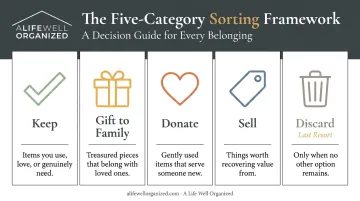
Professionals help seniors apply this consistently across hundreds or thousands of items — without feeling overwhelmed or pressured into decisions they'll regret.
Why Floor Planning Matters Before You Sort
Knowing the dimensions of the new space before sorting begins is essential. Every "keep" decision should be grounded in the reality of where the item will actually live.
This is especially true in NYC, where the 2023 Housing and Vacancy Survey found that 54% of Manhattan housing units are studios or one-bedrooms. Moving a full dining set into a 600-square-foot apartment creates an immediate problem — and one that's entirely avoidable with a floor plan drawn up before a single item is packed.
The Move-In Reveal
When a professional organizing team sets up the new home according to a pre-agreed floor plan before the senior arrives, the result is striking. Walking into a space where everything is already in its place — not surrounded by towers of boxes — transforms the emotional experience of arrival. That first impression matters more than most families anticipate.
How Much Do Senior Downsizing and Moving Services Cost?
Costs vary based on home size, volume of belongings, move distance, location, and scope of services. There's no universal project total, and any provider claiming otherwise before assessing your situation should be viewed with skepticism.
The Hourly Rate Benchmark
According to AARP, citing NASMM's association-wide survey, senior move managers typically charge $60–$120 per hour, with higher rates in the Northeast and California. In metro areas like NYC, expect rates toward the upper end of that range.
Two Billing Models
- Hourly rates — Common for move managers; costs scale with the time required
- Project-based packages — Offer budget predictability; better for families who want a fixed scope
Reputable providers always supply a detailed written estimate before any work begins — if a provider won't commit to writing, that's reason enough to look elsewhere.
The Investment Argument
Understanding the billing structure is only half the picture. The upfront cost of professional services often generates real savings:
- Smaller moving trucks needed when decluttering is done properly beforehand
- Recovered value through estate sales and appraised resale of valuables
- Tax documentation for charitable donations
- Avoided costly mistakes like moving furniture that won't fit
- Reduced family time off work managing a chaotic process

For complex, high-stakes transitions, professional services pay for themselves — financially and emotionally.
How to Choose the Right Senior Moving and Organizing Service
Credentials to Look For
Two credentials signal meaningful professional accountability:
- NASMM membership or SMM-C certification — for senior move managers. The SMM-C individual credential requires at least 40 invoiced senior-move projects, nine competency courses, and 45 continuing education credits every three years. NASMM A+ company accreditation requires even more rigorous standards.
- NAPO CPO certification — for professional organizers. Requires 1,000 paid work hours, a 125-question exam, and recertification every three years.
These credentials signal verified training, ethics standards, and a genuine commitment to best practices — not just membership dues paid.
A Life Well Organized (ALWO) is NAPO-certified and specializes in senior relocations, downsizing, estate clearances, and complex multi-destination moves across NYC and the Tri-state area. Credentials matter — but so does the person behind them.
A note on fit: The relationship between a senior and their move manager is deeply personal. Compatibility, patience, and trustworthiness matter as much as credentials — sometimes more. Let the senior meet with prospective providers before committing.
Key Questions to Ask Any Provider
- How do you handle emotionally difficult downsizing decisions?
- What is included in your written estimate?
- Do you have a trusted vendor network, and how do you coordinate them?
- How do you handle items the client no longer wants?
- What is your experience with moves of this type and scale?
- Are your workers employees or subcontractors?
- Do you carry liability and workers' compensation insurance?
Frequently Asked Questions
How much do senior move managers charge per hour?
Senior move managers typically charge $60–$120 per hour nationally, according to NASMM's association survey cited by AARP. Rates run higher in metro markets like NYC. Total project costs vary widely based on home size, scope of services, and the number of sessions required.
Are senior move managers worth it?
For complex moves, yes. A good senior move manager reduces family stress, prevents conflict between adult children, recovers value from unwanted items through estate sales, and ensures a smoother emotional transition — benefits that a simple cost comparison rarely captures.
What is the difference between a senior move manager and a regular moving company?
Traditional movers handle the physical transport of goods. Senior move managers support the entire transition — from planning and downsizing through emotional support, vendor coordination, and post-move setup. Unless a company explicitly offers both, these are separate functions.
How far in advance should you start the senior downsizing process?
Starting 8–12 weeks before the move is the standard recommendation — and earlier is always better. This window allows for thoughtful sorting and prevents the rushed decisions that pile up when everything gets left to the final weeks.
What happens to belongings seniors don't want to keep?
A professional coordinates multiple options: gifting to family members, estate sales with proper appraisals, charitable donation with tax documentation, creative reuse programs, and responsible disposal. The goal is to find the right home for each item rather than defaulting to disposal.
How do I know when it's time to downsize?
Common signs include: maintaining the current home has become physically or financially burdensome, the space is larger than needed, a health change has occurred, or being closer to family and community has become a priority. If any of these resonate, a consultation with a senior move specialist is a good next step.