
That's changing. High-net-worth homeowners across NYC and the Tri-state area increasingly want integrated solutions where design and organization are planned together, not stitched together after the fact.
This article covers what actually defines luxury design, the core principles behind well-optimized spaces, two design rules worth knowing, and how to keep a beautifully organized home that way.
Key Takeaways
- Luxury design and organization work as one integrated system
- Scale, traffic flow, and proportion determine whether a high-end room actually works
- The 3-5-7 and 70/30 rules give you practical frameworks for styling and layout
- Custom, sustainable organization systems keep a space beautiful long-term
- Coordinating designers and organizers early prevents expensive redesigns later
What Defines Luxury in Interior Design and Space Organization
Luxury is intention: every material, every drawer, every sightline chosen on purpose.
Natural materials do a lot of the heavy lifting here. Marble, solid wood, linen, and brushed metal show up not just in furniture but in storage elements too: a linen-lined drawer, a marble vanity tray, a wooden closet system. According to Architectural Digest Middle East, enduring materials like these — paired with warm, earthy tones — define what's now called "quiet luxury."
Custom Craftsmanship as a Luxury Standard
Off-the-shelf furniture fits a room. Custom furniture fits your room, down to the inch.
That precision matters for storage, too:
- Built-in shelving that uses every inch of an awkward alcove
- Closet systems measured to a specific wardrobe, not a generic template
- Pantry drawers sized for actual dishware, not guesswork
This is the line between a nice home and a true luxury one: nothing is approximate.
The "Quiet Luxury" Aesthetic
According to House Beautiful, quiet luxury runs on restraint: warm wood, silk, velvet, a tight neutral palette, and nothing screaming for attention.
In a living room, that might mean one dominant tone across upholstery, rug, and walls, with texture doing the work instead of pattern. In a closet, it's the same idea applied to storage: uniform hangers, matching bins, a single color story for boxes. Uniformity isn't boring; it's what makes a space feel calm.

Core Principles of Space Optimization in Luxury Homes
Good design starts with scale and proportion. A grand living room needs statement furniture: an oversized sectional, a sculptural coffee table. Drop that same piece into a cozy den and it overwhelms the room. Smaller spaces call for smaller-scale, more intimate furniture. Mirrors are underused. Placed opposite a window or light source, they visually double a room's depth while bouncing natural light around. The same trick works in a foyer as easily as a primary bedroom. Traffic flow is where a lot of beautiful rooms fail. If you have to angle around a coffee table to reach the couch, the layout isn't finished. Every path through a room should feel effortless. A few other non-negotiables:
- Carry a cohesive color palette of two or three tones through every room to tie organization and design together
- Choose fewer, better pieces so architecture and craftsmanship stand out
- Treat clutter as a real cost — it undermines the calm luxury design is meant to create That last point is backed by research. A peer-reviewed study by Saxbe and Repetti found that people who described their homes as cluttered showed flatter cortisol patterns and more depressed mood over the following days, while those with restorative home descriptions showed the opposite pattern. Clutter isn't just an eyesore in a luxury home. It works against the calm the design is trying to create.

Design Rules Every Luxury Homeowner Should Know
Two simple ratios keep luxury rooms feeling intentional instead of overdone.
What Is the 3-5-7 Rule in Decorating?
Group decorative objects in odd numbers—three, five, or seven—at varying heights. Odd numbers and mismatched heights look deliberate and curated, according to Homes & Gardens. Use it on mantels, console tables, or open shelving where objects should feel chosen, not merely placed.
What Is the 70/30 Rule in Interior Design?
Let one dominant style or palette cover 70% of a room, and reserve 30% for contrast: a different texture, era, or accent color. Homes & Gardens describes this as the ratio that keeps a room sophisticated without slipping into monotony. Too much uniformity feels sterile; too much contrast feels chaotic.

Room-by-Room Luxury Organization Strategies
Luxury organization works room by room: each space gets systems that look intentional and stay easy to live with day to day.
Kitchen and pantry
Clear counters and calm sightlines set the tone for the whole home. Build storage that hides workhorse items while keeping them one motion away.
- Install custom pull-out systems so prep tools stay accessible without crowding the counter
- Swap mismatched packaging for uniform glass canisters that read as a single display
- Use appliance garages for the coffee maker and blender without losing daily access
- Zone the pantry by frequency of use so everyday staples stay at eye level
Closets and bedrooms
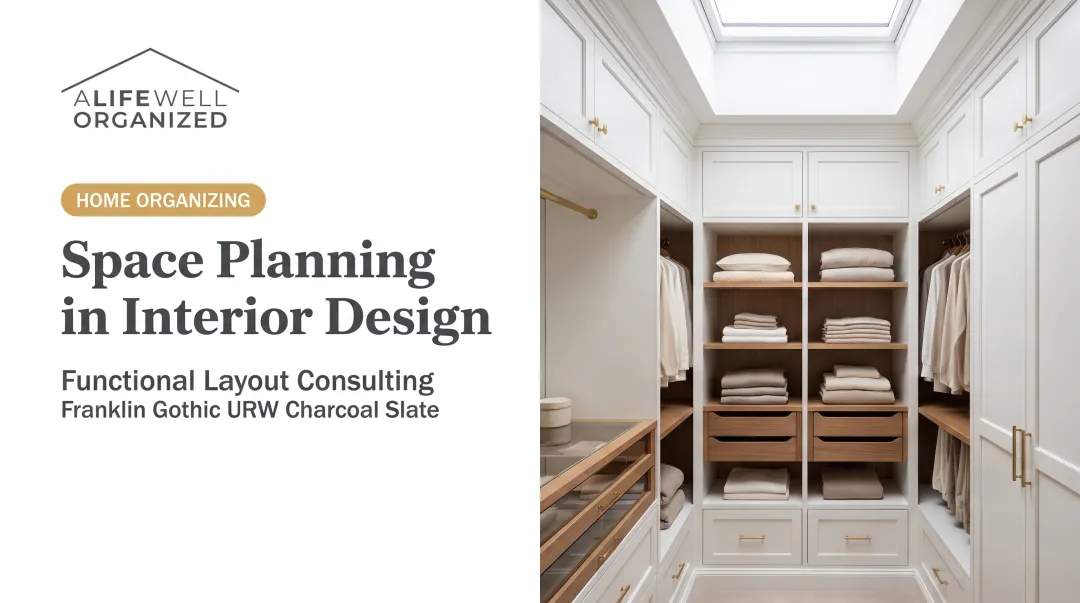
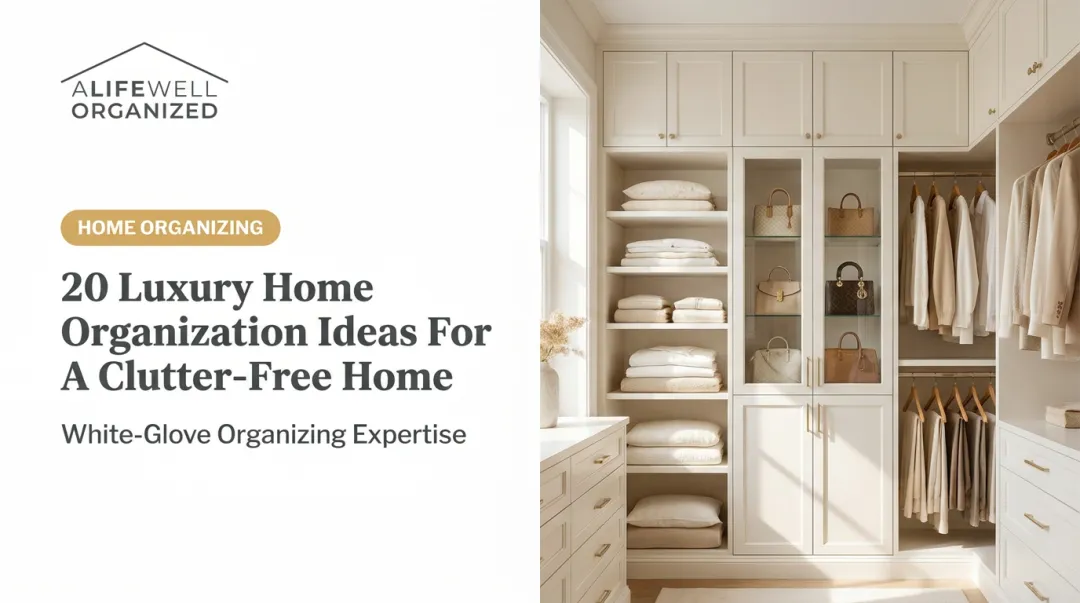
A well-built closet should feel like a private boutique, not a storage closet. Lighting, hardware, and edit discipline do most of the work.
- Add automated rotating racks and integrated lighting for a true dressing-room feel
- Standardize on matching wooden hangers so the rail looks intentional
- Arrange a capsule wardrobe by color or category to make getting dressed effortless
- Give off-season pieces a labeled, out-of-sight home so the active wardrobe stays lean
Bathrooms and entryways
These rooms are first and last impressions. Small, styled systems create hotel-level calm without clutter.
- Display towels hotel-style in neat rolls or stacks for a finished look
- Fit drawer dividers so vanity essentials stay sorted and easy to grab
- Style the entry with one tray, a catch-all, and a single sculptural object
- Limit surfaces to daily-use items only; store backups behind closed doors
Living spaces and studies
Shared rooms stay luxurious when everyday objects have a designated, attractive home. Containment should look like décor, not storage.
- Corral remotes and coasters on decorative trays so tables stay clear
- Hide blankets in natural-material baskets that blend with the room
- Treat a home library as a design feature with custom shelving, not open piles
- Give the study a single landing zone for mail and devices to stop desk creep

Working with Design and Organization Professionals
Bringing in a designer and an organizer at different stages usually backfires. The designer specs cabinetry without knowing what actually needs to fit inside it. The organizer arrives after the fact and has to retrofit a system into a space that wasn't built for it. Coordinating both early means storage gets built into the design, not bolted on afterward.
A Life Well Organized leads the organizing side and collaborates with your design team when layout or cabinetry is still open—so what you keep actually drives the plan. That early work runs through ALWO’s four-phase Signature Method:
- Discover: consultation on lifestyle, goals, and vision, then a tailored proposal
- Declutter: guided sorting of what stays and what goes
- Organize: full-service implementation using spatial sense, symmetry, and psychology
- Balance: habit-centered systems so the order holds after the team leaves

ALWO is fully service-based: consultation, decluttering, hands-on organizing, and functional design consulting—not product retail or trade-account selling.
Discretion matters as much as design skill. Working inside someone’s home—especially during a move or estate clearance—means handling sensitive information. ALWO builds a non-disclosure clause into every client agreement and keeps a strict confidentiality policy for high-net-worth households.
Maintaining a Beautifully Organized Luxury Home
The best-designed closet in the world falls apart in six months without a maintenance habit. Two rules keep systems intact:
- One-in-one-out: a new item means an old one leaves, keeping volume constant
- Seasonal editing: a quarterly pass through closets, pantries, and drawers catches drift before it becomes clutter
Systems also need clear categories, consistent labeling, and logical proximity. Cooking oils live near the stove, not in a back pantry corner. That's what makes a system usable by the whole household, not just the person who set it up.
Those habits protect more than daily calm. NAR's 2025 Profile of Home Staging found that 29% of surveyed agents reported staged homes sold for 1-10% more, and 49% said staging reduced time on market. An organized, well-presented home is easier to live in and stronger at resale.
Frequently Asked Questions
What is the 3-5-7 rule in decorating?
Group decorative objects in odd numbers of varying heights (three, five, or seven pieces) for visual balance. It's commonly used on mantels, shelves, and console tables in luxury styling.
What is the 70/30 rule in interior design?
Dedicate 70% of a room to one dominant style or palette, and 30% to contrasting accents. This keeps a space cohesive without feeling flat or repetitive.
How is luxury organization different from standard home organization?
Luxury organization uses custom-fit systems, premium natural materials, and designs integrated with the home's overall aesthetic. It's built to last, not just to tidy up temporarily.
Should I hire an interior designer and a professional organizer separately or together?
Bringing them in together, early, ensures storage needs shape the design instead of being retrofitted later. It also prevents costly redesigns down the line.
What are the best materials for luxury storage and organization?
Natural, premium materials such as wood, glass, marble, and linen hold up over time and blend organization seamlessly into a room's design.
How do I keep a luxury home organized long-term?
Follow a one-in-one-out rule, do seasonal edits, and keep categories, labels, and storage locations logical. Those habits are what keep the system working year after year.