This guide skips the generic "just post more on Instagram" advice. Instead, it walks through a prioritized system: website, search visibility, content, referrals, and credibility-building that actually converts strangers into paying clients.
These lessons come from building A Life Well Organized (ALWO) into a premier NAPO-certified organizing firm serving NYC's elite since 2017. What worked wasn't luck. It was a deliberate marketing stack, built one channel at a time.
Key Takeaways
- Social media builds awareness, but email and search drive actual bookings
- A website with clear calls-to-action functions as your hardest-working salesperson
- Referrals remain the top lead source for established home-service businesses
- Credentials like NAPO certification and a documented methodology justify premium pricing
- Small, steady marketing efforts outperform sporadic bursts of activity
Why Social Media Alone Won't Fill Your Client Roster
Social media feels productive. You post a stunning pantry transformation, get a few hundred likes, and feel like you're marketing. The problem? Algorithms severely limit who actually sees that post.
Instagram's average organic reach rate sits at just 3.50%, down 12% year-over-year. Facebook fares worse, averaging 1.65% reach, according to Socialinsider's 2025 benchmark data. If you have 500 followers, that means roughly 8 to 17 people actually see any given post.
Compare that to email. Litmus's 2025 survey found that 35% of companies earn $10 to $36 for every $1 spent on email marketing, and another 30% earn $36 to $50 per dollar, based on a global survey of nearly 500 marketing professionals (Litmus, 2025). That's not a marginal difference. That's a different category of return.

None of this means social media is worthless, though. It just means the platform deserves a smaller role than most organizers give it.
What Social Media Is Actually Good For
Social media still matters. It just plays a supporting role, not the lead role:
- Portfolio and proof of work: showing before/after transformations builds visual credibility
- Staying top of mind: past clients and referral partners see you're active and thriving
- Warming up leads who found you elsewhere before they reach out
Treat it like a storefront window, not a sales floor. The rest of this guide covers what actually fills the sales floor: your website, search visibility, email, and referrals.
Build a Website That Works as Your 24/7 Salesperson
Instagram can suspend your account tomorrow. Facebook can change its algorithm overnight. Your website is the one asset you fully own. That alone makes it the most important marketing investment a professional organizer can make.
Must-have pages:
- Home — speaks directly to pain points, not company facts
- About — client-focused, answering "can this person help me?" not just your résumé
- Services — clear packages or categories, not vague descriptions
- Before/After Gallery — visual proof, updated regularly
- Blog — answers common client questions (more on this below)
- Contact — with a form that's easy to find and easy to fill out
Every page needs a clear call-to-action. ALWO's site, for example, uses CTAs like "Schedule a Consultation" and "Let's Get Organized" repeatedly across service pages, all funneling to a contact form and then a complimentary Zoom evaluation call.

That two-step structure, inquiry followed by a low-pressure consultation, removes friction at exactly the point where prospects hesitate.
The Psychology of Speaking to Pain, Not Features
Most organizers write their homepage like a résumé: certifications first, services second, maybe a testimonial buried at the bottom. Flip that.
Lead with the client's emotional state. Words like "overwhelmed," "chaotic," and "stressed" resonate because that's the actual language clients use in consultations, not "I need decluttering services." ALWO's own positioning leans on this directly, promising to move clients "from chaos to calm" and restore "emotional freedom." That's not fluffy branding. It's mirroring what clients say before they even hire you.
Optimize for Local Search So Clients Find You First
Local SEO means showing up when someone searches "professional organizer near me" or "[city] home organizer." That requires:
- Keyword-optimized page titles, meta descriptions, and headings
- Location-specific service pages (a Manhattan closet organizer page performs differently than a general "closet organizing" page)
- A fully completed Google Business Profile
That last point matters more than most organizers realize. BrightLocal's survey of local-search experts assigns 32% of Local Pack ranking influence to Google Business Profile signals — more than reviews or on-page SEO individually (BrightLocal, 2026). Profiles with more than 100 photos also see 520% more calls than average, based on BrightLocal's analysis of 45,000 profiles.
SEO-driven leads also tend to convert better because the searcher already has intent. Someone typing "estate organizing NYC" isn't casually browsing; they need help now.
That same intent-driven visitor will size up your pricing just as quickly. Even rough ranges or example project costs on your website filter out tire-kickers and build trust before the first call. Vague pricing leaves prospects to guess, and guessing usually ends with them clicking away to a competitor who was upfront.
Turn Content and Email Marketing Into a Client Pipeline
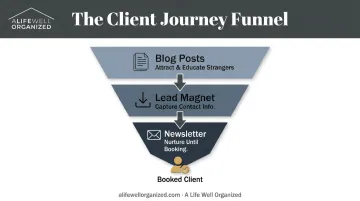
Here's the funnel logic: blog posts attract and educate strangers, a lead magnet captures their contact information, and a monthly newsletter nurtures that list until they're ready to book.
Blog posts work best when they answer real client questions — the ones you hear on every consultation call. ALWO's own New Client FAQ addresses exactly this: how to prepare for a first session, whether clients need to tidy up beforehand (they don't), and how confidentiality is handled. That's blog gold. Write from the emotional angle — the why behind the mess — rather than a dry list of services.
Build a Newsletter That Actually Gets Opened
A small list is still worth nurturing. Even 10 to 60 subscribers can generate real business through forwards and referrals. One subscriber who forwards your newsletter to a friend moving apartments is worth more than 500 passive Instagram followers.
The high-converting formula: one point, one call-to-action, one photo of yourself.
That's it — don't cram in five tips and three links. A newsletter that just says "check out my latest blog post" pulls readers away from booking instead of toward it.
Campaign Monitor's industry benchmarks show professional services average a 19.3% open rate and 2.1% click-through rate across more than 100 billion analyzed emails (Campaign Monitor). Track clicks and consultation requests, not just opens — opens can be inflated by privacy features.
Lead Magnets That Reduce Fear, Not Just Collect Emails
Every newsletter needs subscribers to nurture in the first place, and that's where lead magnets come in. The best lead magnet topics target the fear of the unknown. Think:
- "What to expect during your first organizing session"
- "Do I need to clean before you arrive?" (spoiler: no)
- "How confidential is this process?"
ALWO already covers this ground in its FAQ, reassuring clients that no pre-cleaning is required and that a strict confidentiality policy with non-disclosure clauses covers every engagement. Packaging that reassurance into a downloadable guide builds trust before the sales conversation even starts.
Turn Referrals and Strategic Partnerships Into Your #1 Lead Source
Referrals consistently outperform every other channel for established organizing businesses, and the data backs this up across home services. Jobber's 2026 survey of 1,050 US home-service business owners found 59% named referrals as a top lead source, tied with repeat work. That trust factor is well documented: people consistently rate recommendations from friends and family above every other form of marketing.
Trust is already built when a referral walks in the door. You're not starting from zero.
Reconnect With Past Clients — They Often Forget To
Clients frequently intend to call you again, or refer a friend, and simply forget. A short check-in every few months — "thinking of you, happy to help with any new spaces" — reopens that door without feeling salesy.
Build Partnerships With Complementary Businesses
The organizers with the fullest client rosters rarely rely on cold outreach. They build referral ecosystems with:
- Real estate agents preparing homes for listing or handling estate sales
- Interior designers who need spaces cleared before a redesign
- Estate managers and attorneys overseeing complex clearances
- Movers who see disorganized homes daily and can point clients your way
ALWO's vendor network shows what this looks like at scale: white-glove movers, art movers and hangers, appraisers, cleaners, stagers, and real estate partners, all built over years through positive client outcomes.
Real estate agents benefit at no cost to themselves, since services are contracted directly with the client. That incentive to refer repeatedly is part of why ALWO can support large, multi-destination moves and estate clearances that a solo organizer couldn't handle alone.

Build Authority and Credibility to Attract Premium Clients
Certifications answer a question every prospect silently asks: is this person actually qualified, or just enthusiastic about closets? Three elements build that trust fastest: credentials, a named methodology, and visible proof.
NAPO certification (National Association of Productivity and Organizing Professionals) requires 1,000 documented experience hours over five years, with at least 750 of those being paid work, plus a comprehensive exam covering organizing principles, ethics, and client care. That's not a weekend course. It's a real vetting process, and citing it reassures prospective clients they're hiring a professional, not a hobbyist.
A defined methodology does similar work for credibility. Vague process descriptions ("we help you declutter and organize") don't justify premium pricing. A named, structured framework does. ALWO's four-phase Discover, Declutter, Organize, Balance method turns expertise into something memorable and brandable — clients know exactly what they're paying for and what happens at each stage.

Testimonials and before/after transformations close the loop. Prospective clients are inviting someone into their personal space and possessions — they want proof first. BrightLocal's consumer review survey consistently finds that the vast majority of consumers read local business reviews before deciding who to hire. Display them prominently, not buried on a separate page.
These three elements work together:
- Credentials prove baseline competence and ethical standards
- A named methodology justifies premium pricing over generic "declutter and organize" offers
- Testimonials and before/afters give prospects the visual proof they need before inviting a stranger into their home
Frequently Asked Questions
What qualifies you as a professional organizer?
Credibility typically comes from a mix of hands-on experience, industry certifications like NAPO, and a documented track record of client transformations, rather than a single formal license. Testimonials and a defined methodology reinforce that credibility.
How long does it take to start getting consistent clients?
Most organizers spend a year or more building trust and visibility. Steady referrals and bookings come from consistent, ongoing marketing, not sporadic bursts of effort.
Is social media enough to market a professional organizing business?
No. Social media alone rarely generates enough qualified leads. It works best as a supporting portfolio tool alongside a website, local SEO, and email marketing.
Do I need a website before I start marketing my organizing business?
Not on day one, but it should be a near-term priority. It's the platform that converts strangers into leads and builds long-term credibility that social profiles simply can't match.
How much should a new organizer spend on marketing?
Start with low-cost, high-ROI channels: referrals, local partnerships, and email marketing. Track results closely before investing in paid ads or larger budgets.
What's the fastest way to get my first few organizing clients?
Lean on your personal network — past colleagues, friends, and family — for initial referrals. Simultaneously set up a basic website and Google Business Profile for ongoing visibility beyond that first wave.