Introduction
The kitchen is where most households begin and end their day — coffee in the morning, dinner cleanup at night. It's also the room that collects clutter faster than any other. Mail drifts in, appliances multiply, and pantry shelves develop a geography no one can explain.
The frustrating part? Most kitchen organization attempts fail not because people lack effort, but because they start in the wrong place. Buying storage bins before decluttering, organizing one drawer while ignoring the rest, or treating the countertop as overflow — these are patterns that lead to a tidier version of the same problem.
This guide takes a different approach: zone-by-zone, declutter-first, and built around systems that hold up in real households. Whether you're working through it yourself or bringing in professional help, each section gives you a concrete method — not just ideas — for making the change stick.
Key Takeaways
- Declutter before buying any organizer; the right containers only become obvious once you know what's staying
- Treat the kitchen as distinct zones (counters, pantry, cabinets, drawers), each with its own logic
- Visibility is the most critical factor in a pantry that stays organized
- A 5-minute evening reset outperforms any storage product over time
- Seasonal maintenance prevents accumulation from quietly undoing your work
Why a Clutter-Free Kitchen Changes More Than You Think
Environmental clutter doesn't just look bad — it affects behavior. Research published in the journal Environment and Behavior found that participants in a chaotic kitchen consumed significantly more food than those in an orderly one, with out-of-control participants eating 103 calories of cookies versus 38 calories for their in-control counterparts. The kitchen environment shapes choices, not just moods.
The practical consequences are direct:
- Forgotten pantry stock drives food waste — ReFED estimates date-label confusion alone causes nearly 1.5 million tons of at-home food waste annually, with 43% of adults reporting they always or usually discard food near or past its label date. A visible, well-rotated pantry directly addresses this.
- Invisible inventory leads to duplicate purchases. Two jars of cumin, three bags of pasta, forgotten canned goods pushed to the back — these are money and space losses that compound over months.
- A counter buried in appliances, mail, and produce bags isn't a workspace. It actively slows down meal prep.
A well-organized kitchen is an operational asset. It determines how efficiently the household runs, how much food gets used rather than wasted, and how much friction builds up in everyday routines.
Declutter First: The Non-Negotiable Starting Point
The most common kitchen organization mistake is reaching for bins before completing a full edit. The result is neatly organized clutter — a tidier version of the original problem. Professional organizers, including the National Association of Productivity and Organizing Professionals (NAPO), treat decluttering as the prerequisite step before any storage system is introduced.
The Professional Decluttering Sequence
Work one zone at a time rather than pulling everything out at once:
- Remove everything from a single zone (pantry shelf, one cabinet, a drawer)
- Sort into keep, donate, or discard — nothing goes back unchecked
- Check expiration dates on all pantry items before returning them
- Only return items that earned their place
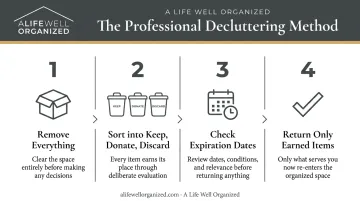
That sequence isn't accidental — it mirrors the methodology professional organizers use in practice. ALWO's four-phase Signature Method — Discover, Declutter, Organize, Balance — builds it into every kitchen project. The Declutter phase means mapping out everything in the space before buying a single bin. As ALWO's team puts it directly: "Before bringing in new bins, shelves, or other storage solutions, we first assess what you already have and determine what's truly needed." Containers bought too early often end up holding items that should have been donated.
The Emotional Side of Kitchen Decluttering
Sentimental gadgets, gifts, and "just in case" duplicates are the most common stumbling blocks. A practical test helps cut through that hesitation:
- If you haven't used it in 3 months, it belongs in the donate pile
- Novelty gadgets that do one task rarely justify the drawer space
- If it requires creative stacking to store, it's not earning its spot
Donating Rather Than Dumping
Items leaving one household can serve another. Food banks, community organizations, and creative reuse centers accept kitchen goods that are still functional. ALWO's team member Jenny champions exactly this — sustainability is one of the company's core values, and donation logistics (including arranging drop-offs) are part of their decluttering service.
Make Maintenance Recurring
Decluttering isn't a single event. Build in brief seasonal edits: pantry once per quarter, cabinets twice a year. This prevents the slow accumulation that undoes a major organizing effort.
Zone-by-Zone: Kitchen Organization Ideas That Actually Work
Treating the kitchen as one overwhelming space is what makes it feel impossible. The professional approach breaks it into distinct zones — each with its own logic, its own best practices, and its own priority order.
Kitchen Counters
The core counter principle: a counter is a workspace, not a storage surface. Only items used daily belong on it.
To audit what's currently there, apply a simple daily-use test to every object:
- Used every single day? It earns counter space
- Used several times a week? Consider a nearby drawer or cabinet
- Used weekly or less? It belongs in a cabinet, regardless of how convenient it feels
What must stay on the counter should look intentional:
- Group small appliances or accessories on a tray to contain visual noise
- Use a single utensil canister rather than multiple holders
- Store bread in a bread box or contained vessel rather than in the bag
- Treat the countertop as a curated display, not overflow storage
ALWO's kitchen projects consistently reflect this — counters in their finished spaces hold minimal functional items, with grains, spices, and dry goods relocated into labeled cabinetry.
Pantry and Cabinet Organization
Start with visibility. A pantry only stays organized when you can see everything in it. The foundational system:
- Group by category: baking, grains, snacks, canned goods, spices
- Transfer loose dry goods into clear containers — ALWO commonly sources clear glass jars with bamboo lids and transparent acrylic containers for cereals and bulk goods
- Label every container and shelf section
Practice FIFO (First In, First Out). When restocking, new purchases go behind existing stock. Older items get used first, nothing expires unnoticed, and food waste drops noticeably over time.
Maximize vertical space:
- Shelf risers to create a second tier within a shelf
- Tiered organizers for spice sections
- Lazy Susans for deep shelves or corner cabinets
- Door-mounted racks for spices, wraps, or small packets
The right tool depends on the pantry type. Walk-in pantries benefit from full shelf systems; deep cabinet pantries typically need lazy Susans and pull-out bins most.
Drawers and Hidden Spaces
Drawer organization transforms daily kitchen use because it eliminates the 30-second hunt for a spatula that precedes every cooking session. The principle is simple: every item has exactly one home.
For utensil drawers, dividers are essential — ALWO's kitchen projects feature sectioned drawers with designated spaces for each tool category. For the junk drawer (which every kitchen seems to develop), the real question isn't how to organize it but what actually belongs in the kitchen at all. Papers, random hardware, and non-kitchen items get relocated; what remains gets a divider.
The same logic extends to under-sink and under-shelf areas, which are among the most consistently wasted spaces in any kitchen:
- Pull-out bins make deep under-sink areas accessible
- Hanging baskets under shelves create usable vertical space
- Grouped cleaning supply caddies prevent these areas from becoming a catch-all

The Best Kitchen Organization Tools Worth Investing In
The categories that deliver lasting results:
| Tool Category | What It Does |
|---|---|
| Clear airtight containers | Pantry visibility and freshness |
| Shelf risers | Doubles usable shelf space |
| Lazy Susans | Accessibility in deep or corner spaces |
| Drawer dividers | Every utensil has one home |
| Labeled baskets or bins | Category grouping in cabinets |
| Door-mounted racks | Uses otherwise wasted space |
Measure before buying anything. A container that's 2 inches too wide wastes money and counter space.
On container quality: Consumer Reports tested 25 food storage container sets across two-week freshness tests, leak tests, and drop tests. Results varied widely — some models leaked or failed freshness tests, and one glass model shattered. Seal quality, closure design, and drop durability differ enough to justify evaluating containers before purchasing in bulk.
Don't buy organizers before the declutter phase is complete. The right quantity of containers only becomes clear once you know exactly how much is staying and where it needs to live.
ALWO's product sourcing — which draws from trade relationships with retailers including The Container Store, Crate & Barrel, and Williams Sonoma — happens in the Balance phase, after decluttering and organizing are done. Buying before that point is how clients end up with shelves full of bins they never needed.
Daily and Weekly Habits That Keep the Clutter Away
The best storage system in the world fails without consistent maintenance habits. The good news is that the habits themselves are short.
The evening reset. Five minutes at the end of the day — clear the counters, return items to their designated homes, wipe surfaces. A clear surface stays clear; a cluttered one attracts more clutter. Research on habit formation confirms that repeating a behavior in a stable context and with a consistent cue is what builds automaticity — which is exactly what a nightly kitchen reset creates over time.

The one-in, one-out rule. Every new appliance, gadget, or pantry staple that enters the kitchen should prompt the removal of something no longer needed. This is an informal heuristic rather than a formal standard, but it's effective as an inventory cap that prevents slow accumulation from undoing a major organizing effort.
The weekly pantry check. Five minutes to:
- Rotate stock (new items behind old)
- Toss anything expired
- Refill labeled containers that are running low
- Add depleted items to the shopping list
Frame this as maintenance, not a chore — it takes less time than a single trip through an unorganized pantry looking for something you can't find.
Household alignment. An organized kitchen only stays that way if everyone who uses it understands the system. ALWO's Balance phase addresses this directly: systems are designed to be simple enough for the entire household to maintain, with labeling that makes it immediately clear to anyone where items belong.
For larger households with staff or estate managers, a brief orientation walkthrough at the end of a project can make the difference between a system that holds and one that unravels within weeks.
Frequently Asked Questions
How do you keep a clutter-free kitchen?
Two things matter more than any storage product: every item has a designated home, and someone commits to a daily reset habit. Without both, even a beautifully organized kitchen drifts back toward clutter within weeks.
What is the 3-3-3 rule for decluttering?
It's an informal online heuristic, not a certified organizing framework. The specifics vary by source, but the general idea is to make quick, repeated decisions about what to keep, donate, or discard. Use it as a starting prompt — not a rigid system.
Where do you start when organizing a messy kitchen?
Start with decluttering — not organizing. Then begin with a single zone, such as the countertop or pantry, rather than attempting the whole kitchen at once. Tackling one zone completely is more effective than making partial progress everywhere.
What should not be stored on kitchen counters?
Rarely used appliances (waffle makers, blenders used monthly), mail and paperwork, non-kitchen items that drift in, and food that belongs in the pantry or fridge. The counter is a prep workspace, not a storage shelf.
How do I organize a small kitchen with limited storage?
Prioritize vertical space: shelf risers, wall hooks, and door-mounted racks can double usable storage without expanding your footprint. Declutter more aggressively than you think necessary — in a small kitchen, only items you genuinely use regularly earn a spot. Multi-functional tools help too; fewer items means less to store.