
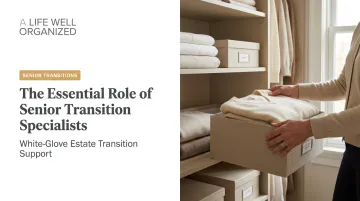
A "senior transition specialist" might sound like a nice-to-have title on paper. In practice, their value shows up in the messier moments: sorting through 40 years of belongings, managing three siblings who disagree about what stays, and coordinating movers while someone's mother worries about her grandmother's china.
This article breaks down what these specialists actually do, why they matter, and how to pick the right one for your family.
Key Takeaways
- Senior transition specialists handle both the logistics and emotional weight of downsizing and moving older adults
- CRTS certification signals formal training, though experienced NAPO-certified organizers often offer equivalent expertise
- The biggest advantages: less family stress, safer decluttering, and coordinated vendor management
- DIY senior moves raise the risk of rushed decisions, family conflict, and costly mistakes
- Start the search early — before a health crisis forces a rushed timeline
What Is a Senior Transition Specialist
A senior transition specialist is a professional who guides older adults and their families through downsizing, moving, and settling into a new home or community. They're typically brought in before a home sale, during a move into assisted or independent living, or when adult children live out of state and simply can't manage the logistics themselves.
The title itself isn't the point. What matters is the outcome: a safe, dignified, low-stress transition instead of a chaotic scramble.
What Is CRTS Certification
Certified Relocation and Transition Specialist (CRTS) is a credential established in 2004, governed under the National Certification Board for Alzheimer Care. To qualify, candidates need a high school diploma or GED, plus one of the following:
- An approved credential, such as CSA or CPO
- A related degree
- Two years of paid senior-care experience
- Completion of a senior-relocation training course
The exam itself is 50 multiple-choice questions in 90 minutes, remotely proctored, with a $350 application and exam fee and annual recertification requiring 4 continuing education units.

Worth knowing: CRTS is one credential among several that signal real competence. Many reputable specialists, including NASMM-affiliated professionals and NAPO-certified organizing teams, bring equivalent expertise through years of hands-on work with senior clients. A Life Well Organized (ALWO), for instance, is NAPO-certified and built its expertise in downsizing, estate management, and complex relocations through direct client work rather than the CRTS route. Both paths can lead to the same result: a specialist who knows what they're doing.
Key Advantages of Working with a Senior Transition Specialist
These benefits aren't abstract. They show up as measurable differences in stress levels, safety, timelines, and family harmony.
Reduced Stress and Time Savings for the Whole Family
Sorting, packing, and coordinating movers is a full-time job for a few weeks. Specialists absorb that burden so families don't have to manage it solo.
In practice, this looks like a room-by-room plan and timeline that frees adult children, who are often juggling their own careers and households, from taking excessive time off work.
The scale of the caregiving burden explains why that time savings counts:
- 63 million Americans were family caregivers in 2025, up 45% from 43.5 million in 2015, per AARP's Caregiving in the US 2025 report
- Caregivers provide an average of 27 hours of care weekly; nearly a quarter provide 40+ hours
- 61% of employed caregivers report work disruptions — arriving late, cutting hours, or taking leave
This advantage hits hardest for out-of-state adult children, multi-sibling decision-making, and moves with tight closing or move-in deadlines. When caregivers already average 27 hours a week on top of full-time jobs, handing off the move itself provides genuine relief, not an indulgence.
Safe, Dignified Downsizing and Decluttering
Downsizing a lifetime of belongings is usually the hardest part of a senior move, both emotionally and physically. Good specialists don't dictate keep/donate/sell/discard decisions. They guide seniors through them collaboratively.
ALWO's approach illustrates this well. Their four-phase Signature Method — Discover, Declutter, Organize, Balance — breaks the process into manageable stages instead of one overwhelming purge:
- Discover — Consultation to understand the client's belongings, destination, and emotional concerns
- Declutter — Collaborative sorting with detailed inventories, so nothing sentimental gets rushed into the wrong pile
- Organize — White-glove setup of the new space, move-in ready from day one
- Balance — Sustainable systems the client can maintain independently

High-value or sentimental estates, multi-generational homes, and situations involving cognitive decline benefit most from this phased structure. Rushed decisions in these cases tend to cause the most regret.
Coordinated, Full-Service Logistics
Specialists manage the entire moving ecosystem: movers, real estate agents, estate sale companies, appraisers, and space planners. Families avoid juggling five vendors on five different timelines.
ALWO describes this role as being like "a travel agent, but for moving." That includes:
- Gathering Certificates of Insurance from vendors
- Sourcing competitive quotes and scheduling movers
- Managing key access and on-site oversight
- Serving as the single point of communication between all parties
Fewer handoffs mean less risk of miscommunication, scheduling conflicts, and lost or damaged items. Complex multi-destination moves, estate clearances, and senior communities with strict move-in windows leave no room for a scheduling slip-up, which is exactly where this coordination pays off.
What Happens When Senior Transitions Go Unsupported
DIY senior moves come with real costs. Rushed decisions lead to regret, and siblings often disagree over what to keep. Physical risk climbs too, especially when someone is lifting boxes or navigating a cluttered, half-packed home.
That physical risk isn't hypothetical. More than 14 million adults 65 and older — over one in four — report falling each year, and the age-adjusted fall death rate climbed 21% between 2018 and 2024, according to the CDC's older adult fall data. A cluttered, in-transition home isn't a safer environment for anyone navigating it, least of all the person it's meant to protect.

Beyond safety, unsupported moves often cost more, not less:
- Last-minute mover bookings at premium rates
- Storage overruns when timelines slip
- Items sold or donated for far less than their actual value simply because there wasn't time to do it right
Perhaps the most overlooked cost is delay itself. When families can't agree or don't know where to start, seniors often stay longer than is safe in homes that no longer fit their needs. This is precisely the gap a senior transition specialist is trained to close, replacing indecision with a clear, coordinated path forward.
How to Choose the Right Senior Transition Specialist
Not every specialist is the right fit for every family. A few things to check before signing anything:
- Credentials and track record — Look for CRTS or NAPO certification, plus specific experience with senior clients, not just general movers
- Service match — Confirm whether you need full-service relocation or a one-off packing/organizing job, and make sure the specialist actually offers that
- Communication style — The specialist should speak directly and respectfully to the senior, not only to the adult children, and adapt to cognitive or physical needs
- References and consultations — Ask for reviews, and take advantage of a complimentary consultation before committing to anything
- Fee transparency — Expect hourly rates (typically $60 to $120 per hour, per AARP's guide to hiring moving managers) or flat package pricing, confirmed in writing
The fee matters less than it seems. A qualified specialist's expertise typically prevents costly mistakes, such as underselling valuables, damaged items, or blown timelines, and those savings outweigh the upfront cost many times over.
Look for firms whose credentials go beyond a certificate. NAPO-certified organizers, for instance, are trained to lead with empathy during emotionally charged transitions, not just manage boxes and logistics.
Conclusion
The real value of a senior transition specialist lies in the combination of empathy, logistics, and expertise applied to one of the hardest transitions a family will go through. Moving day tasks are only the visible part of that work.
That value shows up most clearly in timing: starting the conversation early, before a health crisis forces a rushed decision, consistently leads to better outcomes for everyone involved.
Families in NYC and the Tri-state area looking for a partner who blends white-glove discretion with a proven organizing system can reach out to A Life Well Organized for support through every phase of the transition.
Frequently Asked Questions
What does a senior transition specialist do?
They assess needs, build a moving and downsizing plan, coordinate movers and vendors, and provide emotional support to seniors and their families throughout the process.
What is CRTS certification?
CRTS (Certified Relocation and Transition Specialist) is a credential earned through eligibility requirements, a 50-question exam, and annual recertification covering senior care, relocation logistics, and ethics.
How much does it cost to hire a senior transition specialist?
Costs vary by hourly rate (commonly $60-$120) or flat package pricing. Some specialists work on referral arrangements with senior living communities at no direct cost to families.
What's the difference between a senior transition specialist and a professional organizer?
Transition specialists focus specifically on relocation logistics for seniors, while organizers often offer broader decluttering and design services. Some firms, including A Life Well Organized, blend both skill sets for clients navigating a life transition.
When should I hire a senior transition specialist?
The ideal time is as soon as a move or downsizing decision is being discussed, well before a health crisis forces a rushed timeline.
Are senior transition specialists the same as senior move managers?
The terms are largely used interchangeably. Both describe professionals managing the logistical and emotional aspects of a senior's relocation, though the National Association of Senior Move Managers (NASMM) notes "Senior Move Manager" is technically its own service mark.