
Packing for a move is not a physical task you can power through in a weekend. It's an organizational challenge that rewards sequencing, clear methodology, and the right tools. Start late, skip the system, and you'll spend your first weeks in a new home tearing through unlabeled boxes looking for a phone charger.
This guide walks through a professional organizer's approach to packing — from decluttering before a single box is taped shut to labeling systems, room-specific strategies, and the mistakes that derail even organized people.
Key Takeaways
- Declutter before you pack — moving items you no longer need costs you time, money, and space
- Start non-essential packing 6–8 weeks out; leave daily-use rooms for the final 1–2 weeks
- Keep every box assigned to one destination room and one logical category
- A color-coded labeling system paired with a numbered box index makes unpacking fast and organized
- Pack an essentials bag last and keep it with you — not in the truck
Start Before the Boxes Do: Decluttering as the Foundation
The single biggest packing mistake is packing first and purging later. Moving items you no longer need wastes money on boxes, space in the truck, and square footage in your new home. Professional organizers treat decluttering as the non-negotiable first phase — full stop.
The Keep/Donate/Discard Framework
Work through one room or category at a time. For each item, ask three questions:
- When did I last use this?
- Does it serve my new space?
- Would I buy it again today?
If the answer to all three is no, it doesn't make the move. Sort into three piles — keep, donate, discard — and resist the urge to create a "maybe" pile. Maybe always becomes keep.

"Discard" doesn't mean landfill. If you're in New York City, several organizations make responsible disposal straightforward:
- donateNYC — connects residents with reuse partners across all five boroughs
- Habitat NYC's ReStore — accepts furniture, appliances, and building materials
- Housing Works — offers furniture pickup (fee-based; acceptance not guaranteed)
- Big Reuse — takes dishware, glassware, appliances, and building materials at its Gowanus location
Schedule these pickups before packing day to keep the process moving.
The Psychological Case for Decluttering First
Moving only items you've consciously chosen to bring into your new life changes the emotional texture of unpacking. It feels like curation rather than damage control. When you're exhausted on day two staring at a sea of boxes, that distinction is the difference between dread and momentum.
Wirecutter recommends starting the culling process eight weeks before your moving date, tackling one or two rooms each weekend. Rushed decluttering produces poor decisions — items that should have been donated get packed simply because there was no time to think carefully.
What You'll Need: Packing Supplies and a Central Tracking System
The Essential Supply List
Before you pack a single thing, gather:
- Small boxes (1.5 cubic feet) for books, tools, and other dense items
- Medium boxes (3 cubic feet) for kitchenware, shoes, and small appliances
- Large boxes (4.5–6 cubic feet) for lightweight, bulky items like bedding and lampshades
- Specialty cartons: dish packs, wardrobe boxes, and mirror boxes
- High-quality packing tape and a tape gun
- Permanent markers (multiple — they disappear)
- Packing paper (not newspaper — ink transfers and stains)
- Cushion wrap or foam sheets for fragile items
- Stretch wrap for securing drawers and furniture
Once your supplies are together, assemble a portable packing kit — a bag or small bin with a tape gun, markers, scissors, and labels. Carry it from room to room. Searching for a marker mid-pack can cost 10–15 minutes across a packing session.
Your Moving Binder
Create a central hub — physical or digital — that holds:
- A numbered box index (box number → brief contents description)
- A master task checklist with dates
- Vendor contacts (movers, donation centers, building management)
- Important documents you'll need access to during the move
Keep this binder with you on move day, not in a box. If something goes wrong — a missing item, a scheduling conflict, a question from movers — this is where the answer lives.
How to Pack for a Move Like a Pro: Step-by-Step
Step 1: Start with Non-Essentials and Seasonal Items
Begin 6–8 weeks out with items that are completely outside your daily routine:
- Holiday décor and seasonal items
- Out-of-season clothing
- Books and decorative objects
- Specialty kitchen tools used once or twice a year
This early phase does two things: it creates visible progress (psychologically important) and surfaces additional items for the donate pile. You don't realize how many duplicates or forgotten items you own until you actually pick them up.
Step 2: Pack Room by Room, Category by Category
Every box belongs to one destination room. Mixing items from different rooms is how you end up at 11pm in your new home unable to find your coffee maker because it's in a box labeled "misc."
Within each room, pack by category — cookware together, bedding together, books together. This turns unpacking into a predictable process instead of a guessing game.
The layering technique:
- Heavier items on the bottom
- Lighter items on top
- Crushed packing paper filling any empty space

A half-full box will collapse under weight during transit. A structurally solid, full box stacks safely. Fill every void.
Step 3: Smart Packing for Fragile and Heavy Items
A few targeted techniques here prevent the majority of move-day damage.
For fragile items:
- Pack plates on their edges, not stacked flat — with packing paper between each piece
- Wrap glasses individually, with paper tucked inside the rim
- Give lampshades their own box with padding all around
- Mark fragile boxes clearly on the top and at least one side
For heavy items: Books, tools, and dense kitchen equipment always go in small boxes. Atlas Van Lines recommends keeping packed cartons at 50 lbs or less for safe handling — a large box filled with books will often exceed this and risks the bottom giving out entirely.
- Use what you already own: Towels, blankets, and pillowcases are excellent padding for fragile décor — and they need to be packed anyway. This cuts down significantly on bubble wrap.
Step 4: Pack Your First-Night Essentials Box Last
This box — or bag — gets packed last and travels with you, not in the moving truck. It should contain:
- Toiletries and medications
- A change of clothes for each family member
- Phone chargers and important documents
- First-night bedding
- Basic kitchen items: kettle, a few cups, paper plates
- Toilet paper and a box cutter
- Anything needed immediately by children or pets
Label it clearly. Make it the first thing accessible at the new home. The first evening should not require digging through twenty boxes.
The Labeling and Inventory System That Keeps Every Box Findable
Color-Coded Labeling
Assign each destination room in the new home a specific color. Use colored tape, markers, or stickers. Every box going to that room gets the matching color marker.
The benefit is immediate: movers can route boxes at a glance without reading every label. Boxes end up in the right rooms from the start, which eliminates the downstream chaos of relocating boxes after the movers leave.
What Belongs on Every Box Label
- Destination room
- Brief contents description (not just "Kitchen" — "Kitchen: pots, pans, mixing bowls")
- A "FRAGILE" flag if applicable
- A sequential box number
The Numbered Box Index
As each box is sealed, assign it the next number and record it in your moving binder with a brief contents description. When you arrive at the new home and need something specific, you search the index rather than opening eight boxes.
This system pays off most in the first 48 hours, when fatigue is highest and patience is lowest. Knowing exactly which box holds what — "the good knife is in Box 14" — turns a chaotic unpack into a controlled one.

Room-Specific Packing Considerations
Kitchen
Pack the kitchen last among major rooms (it's used daily) and set it up first in the new home. Pack specialty appliances, platters, and seasonal items weeks ahead. Leave everyday dishes, the coffee maker, and basic utensils until the final two days.
Bedrooms and Closets
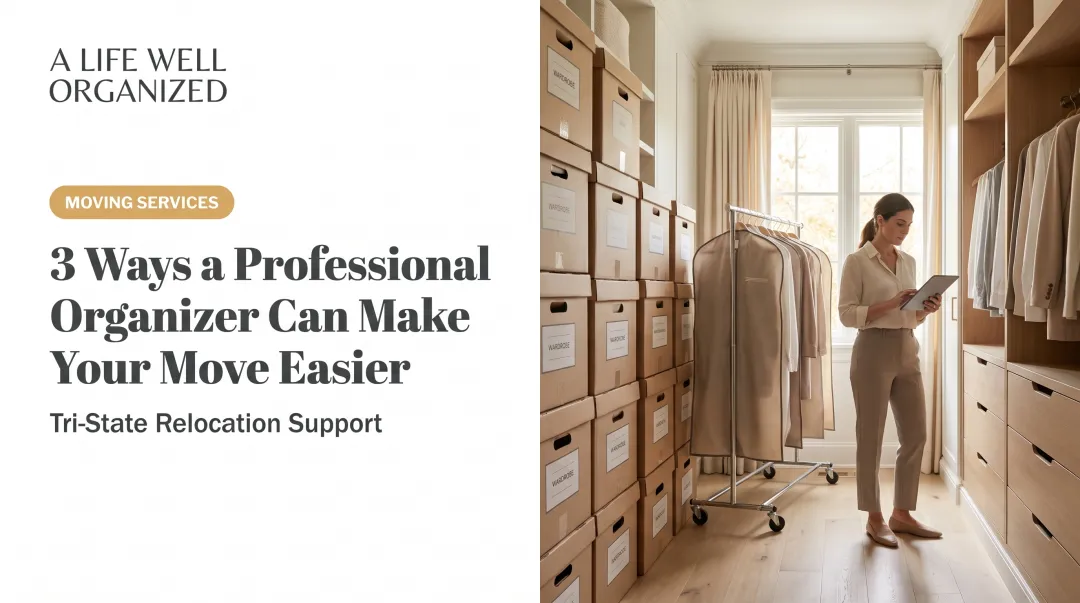
Wardrobe boxes let hanging clothes move directly from closet rod to box without folding. Dresser drawers containing lightweight clothing can often stay intact — secure the drawers with stretch wrap so they don't slide open during transit. This eliminates significant repacking effort for everyday clothing.
Garage and Storage Areas
Treat the garage as a prime decluttering opportunity, not a packing zone. It accumulates miscellaneous items precisely because no one thinks carefully about what lives there — moving is the ideal moment to change that.
Most moving companies will not transport hazardous materials: paint, solvents, propane tanks, aerosols, and similar items. In NYC, full aerosols and flammable materials go to SAFE Disposal Events; latex paint is accepted at Special Waste Sites. Check NYC311 for current schedules before moving day.
Common Packing Mistakes Even Organized People Make
Overpacking Large Boxes
The instinct to fill every box completely leads to boxes too heavy to carry safely. A simple test: if you can't lift a filled box with manageable effort, redistribute the weight into a second box.
Abandoning the Labeling System Under Time Pressure
The last 24–48 hours before a move are when systems collapse. Boxes get thrown together and labeled vaguely — or not at all. The result is unpacking chaos that makes settling into a new home feel overwhelming for weeks.
Aim for consistency on most boxes rather than perfection on none. Even partial labeling beats a stack of unmarked "misc."
Forgetting the Interim Period
People focused on packing often overlook what they'll need during the move itself — especially when there's a gap between leaving the old home and accessing the new one. Plan for this window explicitly, including basic tools and supplies for your first day of unpacking.
When Your Move Deserves a Professional Touch
Some moves exceed what a personal checklist can manage. Multi-destination relocations, downsizing from a large home, estates with decades of accumulated belongings, tight timelines, significant art collections, or the emotional weight of a difficult life transition: these scenarios benefit from professional methodology, vendor relationships, and steady-handed coordination.
A Life Well Organized works with clients across New York City and the Tri-state area on exactly these kinds of moves. Founded by Kenny Metzger in 2017, ALWO's NAPO-certified team approaches every relocation through a four-phase Signature Method: Discover, Declutter, Organize, and Balance — covering everything from pre-move decluttering and inventory creation through unpacking and fully setting up a functional home.
As Kenny describes it, the goal is "producing your new life." That means building the foundation for how you actually want to live, not just moving boxes from one address to another.
For clients who've tried to manage complex moves independently, ALWO also coordinates the full vendor network:
- White-glove movers for high-value and fragile items
- Art specialists for significant collections
- Donation logistics and responsible disposal
- Certificates of Insurance for luxury buildings

The result is a move-in-ready home from day one — no months-long unpacking project, no coordination headaches.
Frequently Asked Questions
How to be organized while moving?
Create a centralized tracking system — a moving binder or digital equivalent — and pack by room and category from the start. A numbered box index lets you locate any item without opening every box. Starting 6–8 weeks out ensures no phase feels rushed.
What is the 3-3-3 rule for decluttering?
There's no universally standardized "3-3-3 rule" — you'll find variations like asking three questions per item or sorting in groups of three. The keep/donate/discard method is the most practical approach: it's simple, decisive, and works for any room.
What is the 80/20 rule in organizing?
The Pareto principle, applied to organizing, suggests most people use roughly 20% of their belongings 80% of the time. Moving is the ideal moment to identify what actually gets used and reconsider the rest.
What are the 4 C's of organizing?
One widely used version is: Clear out, Categorize, Contain, and Create habits for maintenance. Applied to moving, that means clearing each space before packing, sorting by category, choosing appropriate containers, and setting up systems that stay functional after move-in day.
How far in advance should I start packing for a move?
Begin decluttering 8 weeks before your move date. Start actively packing non-essential items 2–3 weeks out, and leave daily-use rooms like the kitchen for the final 1–2 weeks. This two-stage approach prevents the rushed, disorganized packing that leads to unlabeled boxes.
What should go in an essentials box when moving?
Toiletries and medications, a change of clothes for each family member, phone chargers, important documents, first-night bedding, basic kitchen items, toilet paper, and a box cutter. Add anything immediately needed by children or pets. Keep this bag with you — not in the truck.