Introduction
Most family business owners have a general sense of who should take over when they step back. Far fewer have the paperwork to make it happen. A handshake agreement, a verbal promise, or even a detailed strategic plan carries no legal weight when ownership actually needs to transfer — and without enforceable documents, state law steps in and makes the decisions for you.
A 2025 U.S. Bank survey of 1,000 small-business owners found that only 54% of owners planning a transfer to employees or family had a formal succession plan. That gap isn't just a planning problem — it's a documentation problem.
This article walks through the three essential categories of documents every family business needs, what each one does, and how to keep them current so they hold up during an ownership transfer or a legal dispute.
Key Takeaways
- Succession documents fall into three categories: personal estate planning, business governance and ownership transfer, and financial/operational transition records
- Personal documents protect the individual; governance documents protect the entity; operational documents protect continuity
- Without a will, trust, or buy-sell agreement, state intestacy laws determine who inherits and controls the business — regardless of family intentions
- Documents must be reviewed every 3–5 years and after any major life or business change
What Are Family Business Succession Planning Documents, and Why Do They Matter?
Succession planning documents are the legally binding instruments that give a succession strategy its legal effect. A succession plan is a roadmap; the documents are the legal infrastructure that makes that roadmap enforceable.
The distinction matters because a plan without documentation can unravel completely. Consider what happens when an owner dies without a will or trust: New York's intestacy laws under EPTL 4-1.1 determine asset distribution, regardless of what the family intended. Business operations can freeze during probate while heirs dispute control. A buy-sell agreement that wasn't executed — or hasn't been updated in a decade — offers no protection at all.
Three points shape how to approach this:
- Documents and strategy are not interchangeable. A leadership transition plan names a successor; only signed legal instruments transfer ownership and authority.
- Different documents serve different purposes. A will governs what happens to an individual's assets. An operating agreement governs how the business entity functions. These must be coordinated — not created in isolation.
- You don't have to do this all at once. These documents fall into distinct categories tied to different phases of the succession process, and building them phase by phase is far more manageable than tackling everything at once.
Personal Estate Planning Documents
Before any business-specific document can function properly, the owner needs personal estate instruments that cover incapacity and death. These documents protect the individual — and without them, business continuity is at serious risk.
Last Will and Testament
A will specifies how the owner's assets — including their business stake — are distributed after death. Without one, state intestacy laws control the outcome, which may conflict entirely with the family's succession intentions.
One limitation to understand clearly: a will alone does not avoid probate. Business interests passing through a will remain subject to the court-supervised probate process, which can slow the transition significantly and make ownership records temporarily inaccessible.
Revocable and Irrevocable Trusts
Trusts transfer business assets outside of probate — meaning faster transitions, private ownership records, and often meaningful estate tax advantages. For family businesses, that combination matters.
The key distinction:
| Trust Type | Flexibility | Tax Treatment |
|---|---|---|
| Revocable | Can be amended or revoked | Remains in taxable estate |
| Irrevocable | Cannot be easily modified | Can reduce taxable estate value |
Irrevocable trusts, often combined with business valuation discounts, are commonly used for mid-to-large family businesses where estate tax exposure is a concern.
Durable Power of Attorney
This document designates someone to make financial and business decisions on the owner's behalf if they become incapacitated. Without it, a court may need to appoint a guardian — a process that can freeze business operations during exactly the period when someone needs to be signing contracts, managing payroll, and keeping operations moving.
Health Care Proxy and Advance Directive
These address medical decision-making, not business operations — but their absence creates personal crises that spill quickly into the business. Every owner should have them in place before they're needed.
Important limitation: Personal estate documents govern the individual but say nothing about business governance, ownership transfer mechanics, or operational continuity. Addressing those requires a separate set of business-specific documents — the buy-sell agreement, operating agreement, and succession plan itself.
Business Governance and Ownership Transfer Documents
This category governs the business as its own legal entity — separate from the individual owner. These documents define who has decision-making authority, how ownership transfers, and what happens when an owner exits, retires, or dies. They must be aligned with the personal estate documents to avoid conflicts.
Buy-Sell Agreement
Often called the single most important business succession document, a buy-sell agreement defines the terms under which ownership interests can be transferred, sold, or bought out. It covers:
- Triggering events: death, disability, retirement, divorce, or bankruptcy — each requiring a different response
- Valuation method: the formula or process used to price the business at the moment of transfer
- Permitted buyers: which parties (family members, partners, or outside buyers) may acquire the interest
- Funding mechanism: most commonly life insurance policies held on each owner
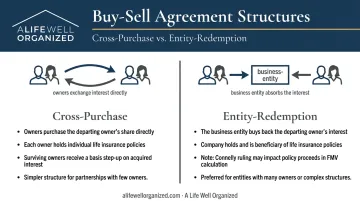
These agreements take one of two structural forms. In a cross-purchase arrangement, remaining owners buy the departing owner's interest directly. In an entity-redemption structure, the business itself buys back the interest. The 2024 Supreme Court decision in Connelly v. United States clarified that corporate-owned insurance proceeds increase the company's fair market value in ways that can affect estate tax calculations — making it essential to review entity-redemption arrangements with an advisor who understands this ruling.
Operating Agreement or Corporate Bylaws
For LLCs, the operating agreement governs how the business is managed: voting rights, dispute resolution, and what happens during a leadership transition. For corporations, bylaws serve the same function. Outdated or vague operating documents are a leading cause of family business disputes, particularly when ownership has shifted but the foundational governance document hasn't been updated to reflect it.
Shareholder or Partnership Agreements
These define the rights and responsibilities of each owner. Succession plans frequently fail because owners drafted these agreements years ago and never updated them to reflect new family members, changed ownership percentages, or evolving business structures.
At minimum, a current agreement should address:
- Voting rights and decision-making thresholds
- Profit distribution and capital contribution obligations
- Exit conditions and right-of-first-refusal clauses
- Restrictions on transferring interest to third parties
Articles of Incorporation and State Filings
Any structural change — adding a successor as a member, transferring the business into a trust, or restructuring the entity — must be reflected in state filings. In New York, this includes biennial statements for corporations and LLCs. Failing to update these creates a legal disconnect between the written succession plan and the official record.
Financial and Operational Transition Documents
These are the documents that keep the business running through the transition, not just after it. They address financial continuity, legal compliance, and the operational infrastructure that supports daily activity. Skipping them until a crisis forces the issue is one of the most common — and costly — mistakes in succession planning.
Business Valuation Report
A professionally prepared valuation is essential for:
- Establishing a defensible transfer price
- Supporting estate and gift tax filings
- Ensuring equitable treatment of heirs who aren't inheriting the business
The IRS closely scrutinizes closely held business valuations and examines governing instruments, sales history, and claimed discounts. An informal owner estimate won't hold up. Valuations should be updated every few years, and definitely before any anticipated ownership event.
Key Person and Life Insurance Policies
Life insurance serves multiple functions in a succession plan:
- Funds buy-sell buyouts when a triggering event occurs
- Provides liquidity to pay estate taxes without forcing a business sale
- Equalizes inheritance for non-business heirs
Key person insurance separately protects the business if a critical leader dies or becomes disabled. One often-overlooked detail: beneficiary designations on these policies must be reviewed and updated to align with the current succession plan. Per the ABA, designation-controlled assets pass under the designation — not under a contrary will or trust — regardless of what other documents say.

Employment Agreements and Protective Clauses
During a transition, key agreements should cover:
- Updated employment terms clarifying roles, reporting structures, and compensation for the incoming successor and critical non-family staff
- Non-compete and confidentiality clauses protecting the business if the outgoing owner or key employees depart
- Retention provisions reassuring valuable staff about their place in the reorganized company
Licenses, Permits, and IRS Records
Business licenses, professional permits, and IRS employer identification records must be updated to reflect new ownership. IRS Form 8822-B handles changes to responsible party information. Operating under outdated registrations can trigger:
- Fines and penalties
- License suspension
- Voided insurance or compliance claims
An entirely avoidable oversight — but one that surfaces regularly during transitions.
How to Organize and Maintain Your Succession Documents
Having the documents is only half the problem. They need to be stored securely, organized so authorized people can find them, and reviewed on a consistent schedule.
A Practical Organization System
Group documents by category, then create a master index for each group:
- Personal estate documents — wills, trusts, powers of attorney, health care proxies
- Governance and ownership documents — buy-sell agreements, operating agreements, shareholder agreements, state filings
- Financial and operational documents — valuations, insurance policies, employment agreements, licenses
For each document in the index, record:
- Document name and type
- Execution date and parties involved
- Location of original (attorney's office, fireproof safe)
- Location of secure digital copy
- Advisor who prepared it
- Date of last review and next scheduled review

Review Cadence
SCORE recommends reviewing succession plans annually, with additional event-driven reviews triggered by:
- Marriage, divorce, or death of an owner or co-owner
- Addition of a new business partner or family member entering the business
- Significant asset growth or business restructuring
- Changes in federal or state tax law
Store originals in a fireproof safe or with the attorney who prepared them. Maintain a secure digital copy accessible to the executor or designated successor — and make sure those people actually know where everything is.
For high-net-worth families managing complex estates, multiple business entities, and multi-document succession plans, that level of coordination is harder than it sounds. A professional organizer with experience in estate transitions can build and maintain systems that actually hold up when they're needed most.
A Life Well Organized works with families throughout New York City and the Tri-state area (including the Hamptons, Westchester, and Connecticut) to create organized, sustainable document systems for estate management and major life transitions. Every engagement begins with a complimentary consultation at alifewellorganized.com/contact.
Common Mistakes to Avoid
Even well-prepared owners run into these three problems — and each one can unravel years of careful planning.
1. Treating succession documents as a one-time task
An outdated buy-sell agreement, a will that predates a new business partner, or a trust that doesn't reflect a major restructuring can be just as damaging as having no documents at all. Every significant business or family change should trigger a review — not just an annual reminder on the calendar.
2. Failing to coordinate across advisors
When the estate attorney, accountant, financial advisor, and business attorney aren't working from the same succession roadmap, conflicts emerge. A buy-sell agreement may contradict the terms of a trust. A life insurance beneficiary designation can override the will entirely. These documents must function as a unified system, not isolated filings.
3. Keeping documents inaccessible to key people
Many owners store succession documents securely — and never tell anyone where they are. In a crisis, family members and advisors lose critical time searching. Make sure these three people know exactly where every document is and how to access it:
- The executor or estate representative
- The designated business successor
- One trusted outside advisor
Frequently Asked Questions
What are the 5 most important estate planning documents?
The five core documents are:
- Last Will and Testament
- Durable Power of Attorney
- Health Care Proxy
- Living Will / Advance Directive
- Revocable Trust
For business owners, a Buy-Sell Agreement is equally essential — it's the one document that specifically governs what happens to ownership when a triggering event occurs.
What are the 7 steps in the estate planning process?
The general steps are:
- Gather financial information
- Define your goals
- Consult an estate attorney
- Draft core documents
- Review all business agreements for alignment
- Execute and store documents
- Schedule regular reviews
Business owners should add a formal business valuation as a critical step before finalizing any ownership transfer documents.
What is the 5 or 5 rule in estate planning?
Under IRC § 2514, the "5 or 5 rule" is a trust provision allowing a beneficiary to withdraw the greater of $5,000 or 5% of the trust's assets annually without triggering gift tax consequences. It's a technical provision relevant for families structuring trusts as part of a broader business succession plan.
When should a family business start preparing succession documents?
Ideally 5–10 years before the planned transition, which provides maximum flexibility to structure ownership transfers tax-efficiently. That said, an emergency succession plan (covering at minimum incapacity and unexpected death) should be in place immediately, regardless of where the business is in its lifecycle.
Do succession planning documents need to be updated regularly?
Yes. Documents should be reviewed every 3–5 years and after any major life or business event — marriage, divorce, death of a co-owner, new partnership arrangements, significant asset growth, or changes in tax law. Outdated documents can be as harmful as having none at all.
What happens if a family business owner dies without succession documents?
State intestacy and probate laws determine how assets are distributed, which may not align with the family's intentions. The business can be frozen during probate, ownership may pass to unintended heirs, and the resulting family conflict or forced liquidation can destroy what took decades to build.