Carrying costs alone tell the real story. Companies typically spend 20-30% of their total inventory value annually just holding stock, covering space, labor, insurance, and handling, according to the Institute for Supply Management. That's not a rounding error. On $100,000 of inventory, you're looking at $20,000 to $30,000 a year in pure holding cost.
Treating storage as "just shelving" leads to lost items, inaccurate counts, and slow fulfillment. This guide breaks down what inventory storage actually is and how it works, step by step.
Key Takeaways
- Inventory storage is a structured system for holding, tracking, and retrieving stock, not just physical space
- It runs on a repeatable cycle: receiving, storing, tracking, and retrieving or replenishing
- Storage methods vary by product type, volume, and how fast items turn over
- Poor storage systems lead directly to overstocking, stockouts, and slower fulfillment
- The same principles apply whether you're running a warehouse or organizing a home office
What Is Inventory Storage?
Inventory storage is the method a business uses to hold, organize, and track products before they're sold, shipped, or used. It combines physical space with an organizational system that tells you what you have and where it is.
Without this system, you can't reliably answer three basic questions:
- What do we have in stock right now?
- Where exactly is it located?
- When do we need to reorder?
Inventory storage is not the same as inventory. Inventory is the actual stock, the physical asset your business owns. Storage is the system that holds and controls it. The Association for Supply Chain Management defines inventory management as tracking stock as it moves in and out while balancing supply and demand.
Storage is also narrower than "warehouse management." Warehouse management covers the entire operational chain: receiving, storing, picking, packing, shipping, plus staffing and dispatch logistics. Inventory storage, by contrast, is specifically about how and where stock sits between arrival and departure. It's one subsystem inside that larger machine, per ASCM's warehouse management framework.
Even with modern inventory software, physical organization still matters. An app can confirm a SKU exists, but it can't make a mislabeled box appear on the right shelf. Software only works when the physical system underneath it is sound — a principle that applies whether you're managing a warehouse pallet or a client's home stockroom.
Types of Inventory Storage
The right physical setup varies by product, volume, and turnover. At A Life Well Organized, this same logic applies when building stockroom systems for business clients across NYC and the Tri-state area — the storage method has to match what's actually being stored:
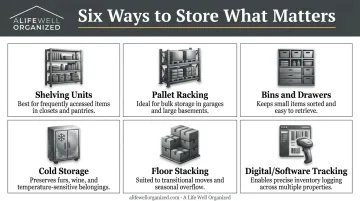
- Shelving units – Standard for small parts, retail stock, and moderate-volume goods
- Pallet racking – Upright frames with horizontal beams for bulk or heavy loads
- Bins and drawers – Subdivide larger storage areas for smaller, high-count items
- Cold storage – Temperature-controlled space for food, pharma, and perishables
- Floor stacking – Direct stacking of tiered materials, often for bulky or short-term goods
- Digital/software tracking – Barcodes, RFID, and inventory software layered on top of any physical method
The process shifts by type. Cold storage demands temperature monitoring; floor stacking doesn't. But every method still follows the same underlying logic: receive it, store it, track it, retrieve it.
How Does Inventory Storage Work?
Inventory storage follows a repeatable four-stage cycle, whether you're organizing a home pantry, a business supply closet, or a boutique stockroom. The stages stay the same regardless of scale.

Initiation: Receiving Inventory
The cycle starts the moment new stock arrives. Before anything gets put away, it needs to be checked for accuracy and condition.
- Manual intake: Common for homes and small businesses. Someone physically checks the delivery against the order or packing slip.
- Simple tracking systems: Even a basic spreadsheet or labeled bin system can flag missing or damaged items before they're stored.
The most common breakdown happens right here. Poor labeling at intake leads to misplaced items, duplicate purchases, and wasted time searching for things later, the exact problems ALWO's organizers solve when setting up a client's storage system from scratch.
Categorization: Sorting by Use and Frequency
Once items are checked in, they need a home based on how often they're used. High-frequency items belong at eye level or within easy reach, while seasonal or rarely used items can move to less accessible storage.
This is where a system like ALWO's Discover and Declutter phases makes a difference. Sorting by actual use, not just by category, prevents the "everything looks organized but nothing is findable" problem common in unstructured spaces.
Storage: Assigning a Permanent Location
Every item needs one consistent spot. Consistency is what makes a system sustainable long after the initial setup.
- Zone-based storage: Group related items together (all cleaning supplies, all seasonal decor, all office paper goods)
- Labeled containers: Clear labels remove the guesswork for anyone accessing the space
- Vertical space use: Shelving and stackable bins maximize small footprints, especially useful in NYC apartments and boutique stockrooms

Maintenance: Keeping the System Working
A storage system only works if it's maintained. Regular check-ins prevent the slow drift back into clutter that undoes the initial organizing effort.
ALWO builds maintenance plans into full-service engagements for exactly this reason. A one-time organizing session creates order, but ongoing upkeep is what keeps a space functional for months and years afterward.