You're not alone. In a 2019 NAPO survey of 1,005 people, 67% said at least some part of their home was disorganized, and closets topped the list of trouble spots at 55% (NAPO, 2019).
Here's the good news: becoming a master organizer has nothing to do with buying more bins. It's about mindset, systems, and habits that stick. This guide walks through 44 practical hints, covering mindset shifts, room-by-room fixes, daily habits, sustainable practices, and knowing when to call in a professional.
Key Takeaways
- Organizing is a learnable system: the right framework beats willpower every time
- Daily 5-10 minute resets prevent clutter from snowballing into weekend-eating projects
- Room-specific strategies outperform vague "get organized" advice
- Sustainable choices (reuse, donation) cut costs and reduce waste simultaneously
- Professionals accelerate results during moves, estate transitions, or overwhelming projects
Master the Mindset: Foundational Principles Before You Organize Anything
Grabbing bins before you've decluttered is the single biggest mistake people make. You end up organizing your clutter instead of eliminating it. Mindset comes first, product comes last.
A Simple Mental Model: Categorize, Condense, Contain, Commit
Before touching a single drawer, try this four-step approach:
- Categorize — Group similar items together so you can see exactly how much you own
- Condense — Cut duplicates, expired items, and anything you haven't touched in a year
- Contain — Assign the remaining items a specific home (bin, shelf, drawer)
- Commit — Decide on a maintenance habit so the system doesn't collapse in a month

This mirrors a popular decluttering approach organizers call the Core 4 Method: Clear Out, Categorize, Cut Out, Contain. Both The Kitchn and a Good Housekeeping breakdown of the Core 4 decluttering method tested this sequence on pantries and closets with strong results. The exact labels matter less than the sequence: sort first, purge hard, then contain what's left.
The One-In-One-Out Rule
Committing to a habit is only half the job. Once your space is decluttered, protect it. The one-in-one-out rule means: buy a new sweater, donate an old one. Match by function and size — jeans for jeans, not jeans for jackets. It won't fix an existing backlog, but it stops new clutter from creeping back in.
Set a Vision Before You Touch Anything
Ask yourself: how do I want to feel in this space? Calm? Efficient? Ready to work? A clear vision guides every decision that follows, from what to keep to how to arrange it.
ALWO's Four-Phase Approach
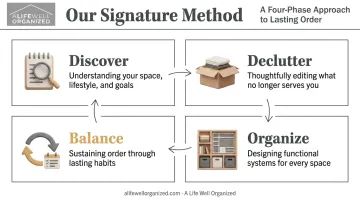
Professional organizers structure this process even further. A Life Well Organized's signature method breaks it into four phases:
- Discover — A consultation to understand your lifestyle, goals, and specific challenges
- Declutter — A guided, compassionate purge with full logistics handled for you
- Organize — Design and implementation, drawing on art, psychology, and spatial planning
- Balance — Habit-centered systems and product sourcing so results actually last
Start small. Pick one drawer or one shelf. Momentum matters more than scale on day one.
Room-by-Room Hints for Everyday Order
Generic advice like "organize everything" rarely works. Room-specific systems do, because a kitchen and a closet solve completely different problems. Here's what actually works in each space.
Kitchen & Pantry
A well-run kitchen depends on visibility — you should be able to see what you have at a glance.
- Install a lazy Susan for condiments and oils so nothing gets lost at the back of a shelf
- Label pantry zones (grains, snacks, baking) so everyone in the house knows where things belong
- Transfer dry goods into clear containers — you'll spot low supplies before you run out
Bedroom & Closet
- Build a capsule wardrobe of versatile pieces to cut decision fatigue every morning
- Use drawer dividers to keep socks, underwear, and accessories from becoming a jumbled pile
- Rotate clothing seasonally, storing off-season items in labeled bins under the bed or on high shelves
Bathroom
- Add drawer inserts to separate skincare, tools, and daily essentials
- Use tension rods under the sink to hang spray bottles vertically, freeing up floor space
- Group items by category (skincare, medicine, tools) instead of by brand or size
Home Office & Paperwork
Paper clutter tends to be the last thing tackled, but it's often the first thing that causes stress.
- Go digital-first: scan documents and shred paper you don't legally need to keep
- Create a "pending action" tray for bills, forms, and anything awaiting a decision
- Manage cords with labeled clips or a dedicated box — untangling cables wastes more time than people expect
Garage, Entryway & Miscellaneous
- Build pallet-style tool storage so every tool has a visible, specific spot
- Use labeled bins for seasonal gear (holiday décor, sports equipment, camping supplies)
- Set up a dedicated key and mail landing zone by the door: it eliminates a huge share of daily searching

Daily and Weekly Habits That Keep Systems Working
Organizing once a year isn't organizing. It's a cleanup. The habit is what separates truly organized people from everyone else.
The Nightly Reset Ritual
Spend 10 minutes each evening putting stray items back where they belong. Research on habit formation shows that automaticity builds through repetition in a stable context. Studies find it takes roughly 66 days on average for a new habit to feel automatic, though this varies by person (habit-formation review, PMC). Small and consistent beats occasional and intense.
Once the nightly reset becomes second nature, a weekly review adds the bigger-picture check that daily tidying can't cover.
Weekly Review Session
Once a week, block 20-30 minutes to:
- Sort through accumulated mail
- Restock depleted supplies (paper towels, toiletries)
- Adjust next week's plan based on what didn't work
These weekly resets work best when paired with a permanent solution for the items that cause the most daily friction.
Give Everything a Home
Keys, chargers, and mail are the three biggest offenders for "floating around the house." Assign each a specific landing spot near the door or charging station, and the daily search for them disappears almost entirely. This is the same principle behind ALWO's maintenance plans: a designated home for every item makes the system self-sustaining long after the initial organizing session ends.

Sustainable and Budget-Friendly Organizing Hints
You don't need to buy new storage products to get organized. Repurpose what you already own first:
- Glass jars become pantry containers
- Shoeboxes become drawer dividers
- Old folders become a filing system
This is a value ALWO's team practices directly. Their process assesses what a client already owns before recommending anything new, and only sources products after decluttering is complete, avoiding the waste of buying bins for items that get purged anyway.
When you do let go of items, donate rather than trash them. In NAPO's 2019 survey, 75.2% of respondents said they donate unwanted goods to a center or charity. That instinct has real environmental payoff: a life-cycle assessment published in the International Journal of Life Cycle Assessment found that reselling just 100 garments can cut human toxicity impact by as much as 45% compared to producing new items.

Locally, look for creative reuse centers that take art supplies, fabric, and household goods off your hands responsibly. ALWO's team, including Administration lead Jenny, actively prioritizes these donation partnerships as part of the company's sustainability commitment.
The bonus: sustainable organizing saves money too. Fewer disposable bins bought means fewer replaced down the line.
When DIY Isn't Enough: Calling in a Professional Organizer
Sometimes a weekend project turns into a multi-room, multi-week ordeal. That's when professional support pays for itself.
When It Makes Sense
- Major life transitions — moving, downsizing, divorce, inheritance, or estate management
- Overwhelming multi-room projects where DIY momentum has stalled
- Limited time or objectivity — sometimes you need a neutral party to help you let go
What It Typically Costs
Professional organizing rates vary by experience, location, and whether pricing is hourly, package-based, or project-based (NAPO, How to Hire). Rather than guessing at a number, most reputable organizers — ALWO included — start with a complimentary evaluation to scope your specific project before quoting.
How ALWO Supports Complex Situations
That evaluation matters most in complex cases, which is where ALWO specializes. A NAPO-certified, white-glove organizing firm serving NYC and the Tri-state area — including Long Island, the Hamptons, Westchester, New Jersey, and Connecticut — ALWO scales its team from one or two organizers for a single closet up to ten for a full estate clearance. Their project experience includes:
- Property separation during divorce proceedings
- Full-home downsizing for retirees and empty nesters
- Multi-layered estate clearances involving heirs and executors
- Complex, multi-destination relocations across state lines
For estate work specifically, ALWO coordinates with appraisers, attorneys, and specialty vendors, applying their four-phase method with white-glove handling of everything from heirlooms to household goods.
Frequently Asked Questions
How much do professional declutterers charge?
Rates depend on whether pricing is hourly or package-based, the project's scope, and your local market. Most organizers, including ALWO, offer a complimentary evaluation to provide an accurate personalized quote.
What are the 4 C's of decluttering?
A common mental model is Categorize, Condense, Contain, Commit: sort items into groups, cut what you don't need, assign homes to what remains, then commit to a maintenance habit—a simple framework anyone can apply without special training.
What is the best organizer for a house?
There's no single "best" system — it depends on your household's needs. That said, clear bins, drawer dividers, and a consistent labeling system work well across nearly every room type.
How long does it typically take to fully organize a home?
Timelines vary widely based on home size, clutter volume, and how many decisions need to be made. Some projects wrap in a weekend; whole-home overhauls with a lot of accumulated belongings can take several weeks.
Can anyone become an organized person, even if they're naturally messy?
Yes. Organization is a trainable skill built through systems and repeated habits, not a fixed personality trait. Research on organizational skills training shows meaningful improvement is possible with the right structure and consistency.
Do I need a professional organizer, or can I do it myself?
DIY works well for smaller projects like a single closet or drawer. Professional help becomes more valuable for complex, multi-room spaces, tight timelines, or emotionally difficult transitions like a move or estate clearance.